The Benefits of Deep Breathing for Stress Relief
Deep breathing exercises are a simple yet powerful tool for managing stress, promoting relaxation, and improving overall well-being. In today's fast-paced world, where stress is prevalent and our breath often becomes shallow and rapid, conscious deep breathing can be a transformative practice. By taking just a few minutes each day to focus on your breath, you can experience a profound shift in your physical and mental state.
Benefits of Deep Breathing:
Reduces stress and anxiety: Deep breathing activates the parasympathetic nervous system, which is responsible for the "rest and digest" response. This helps to counter the effects of the sympathetic nervous system, which triggers the "fight or flight" response associated with stress. By slowing your heart rate, relaxing your muscles, and calming your mind, deep breathing can significantly reduce stress and anxiety levels.
Lowers blood pressure: Deep breathing has been shown to lower blood pressure, which is beneficial for cardiovascular health. By relaxing the blood vessels and improving blood flow, deep breathing can help to reduce hypertension and its associated risks.
Improves focus and concentration: Deep breathing increases oxygen intake, which nourishes the brain and improves cognitive function. This can lead to enhanced focus, concentration, and mental clarity.
Increases oxygen intake: When you breathe deeply, you increase the amount of oxygen that enters your lungs and bloodstream. This oxygenates the cells throughout your body, improving energy levels and overall vitality.
Promotes relaxation and a sense of calm: Deep breathing has a profound calming effect on both the body and mind. By slowing your breathing and focusing on the present moment, you can induce a state of relaxation and reduce feelings of tension and anxiety.
Improves digestion: Deep breathing can stimulate the digestive system and improve digestion. By massaging the abdominal organs and increasing blood flow to the digestive tract, deep breathing can help to alleviate digestive discomfort and promote regularity.
Reduces pain: Deep breathing can help to reduce pain perception by releasing endorphins, which are natural pain relievers. It can also help to relax muscles and reduce tension, which can contribute to pain relief.
Improves sleep quality: Practicing deep breathing exercises before bed can help to calm the mind and relax the body, promoting more restful sleep.
Deep Breathing Techniques:
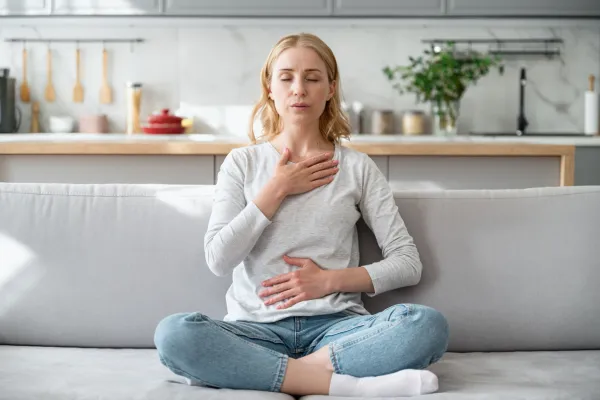
Diaphragmatic breathing (belly breathing): This involves breathing deeply into your abdomen, allowing your belly to expand with each inhale. Place one hand on your chest and the other on your belly. As you inhale, feel your belly rise, and as you exhale, feel your belly fall. This technique helps to engage the diaphragm, the primary muscle involved in breathing, and promotes deeper and more efficient breathing.
Box breathing: Box breathing is a simple yet powerful technique that can help calm your nervous system and improve focus. It involves a four-part cycle of breathing: inhale deeply through your nose for a count of four, hold your breath for a count of four, exhale slowly through your mouth for a count of four and hold your breath again for a count of four. Repeat this cycle several times, focusing on the sensation of your breath and the counting. This rhythmic pattern of breathing can help to slow your heart rate, reduce anxiety, and promote a sense of calm and focus.
Alternate nostril breathing (Nadi Shodhana): This technique involves alternately breathing through each nostril. Use your right thumb to close your right nostril and inhale through your left nostril. Then, close your left nostril with your right ring finger and exhale through your right nostril. Inhale through your right nostril, close it with your thumb, and exhale through your left nostril. Continue this pattern for several rounds. Alternate nostril breathing is believed to balance the energy channels in the body and promote a sense of calm.
Tips for Incorporating Deep Breathing:
Practice regularly: Aim to practice deep breathing exercises for a few minutes each day, even if it's just a few rounds of diaphragmatic breathing. Consistency is key to experiencing the benefits.
Find a quiet space: Choose a quiet space where you can sit or lie down comfortably without distractions.
Focus on your breath: Pay attention to the sensation of your breath entering and leaving your body. Notice the rise and fall of your chest or belly.
Use guided meditations: Guided meditations can be helpful for learning and practicing deep breathing techniques. There are many resources available online and through meditation apps.
Incorporate into your daily routine: Find ways to incorporate deep breathing into your daily routine. You can practice deep breathing while waiting in line, commuting, or before bed.
Tip: Enhance your deep breathing practice with the MyFace Massage Pillow. Its ergonomic design provides optimal support and comfort, allowing you to fully relax and focus on your breath.
Embrace relaxation and pre-order the MyFace Massage Pillow today. Experience the ultimate comfort and support as you incorporate deep breathing exercises into your self-care routine. https://pillowmassageplus.com/
Deep breathing is a simple yet powerful tool that you can access anytime, anywhere. By incorporating deep breathing exercises into your daily routine, you can manage stress, improve your focus, and cultivate a greater sense of calm and well-being.

